John Whitehead's Commentary
When Everything Becomes a National Security Threat

“The word ‘security’ is a broad, vague generality whose contours should not be invoked to abrogate the fundamental law embodied in the First Amendment.” —Justice Hugo Black, New York Times Co. v. United States (1971)
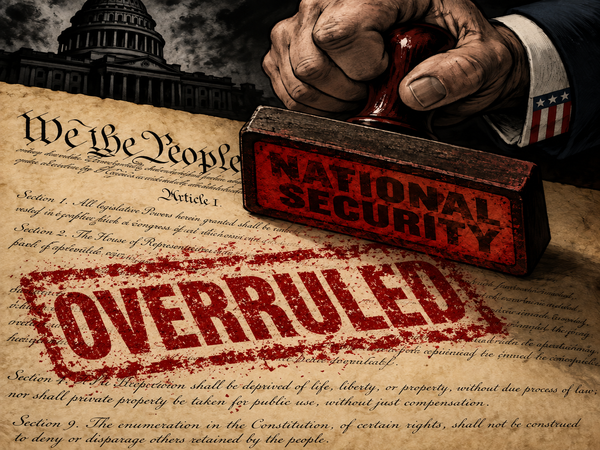
“National security” has become the government’s all-purpose permission slip to behave badly.
They have become the magic words that can make constitutional restraints disappear—especially when the courts defer to claims of national security. Courts have historically been reluctant to second-guess the executive branch when government officials invoke military necessity, classified information, foreign affairs or national security.
Given the judiciary’s longstanding reluctance to second-guess presidential power grabs involving national security, the national-security state has repeatedly used that deference to expand both its own reach and the power of the presidency.
Call something a matter of national security and the normal rules start disappearing: Courts defer. Congress retreats. Secrecy expands. Executive power grows.
“National security” has been used as the justification for surveillance, secret courts, classification, warrantless spying, military intervention, watchlists, detention, border searches, censorship claims and the concealment of government misconduct.
That game is hardly new.
Nixon played it. Bush played it. Obama played it. Biden played it.
Trump may not have invented the national-security dodge, but he has taken it to increasingly absurd extremes.
Under Trump 2.0, almost everything gets branded a matter of national security in order for the president to sidestep as many parts of the Constitution as he finds inconvenient.
At one point, the government even invoked national security to justify proposed tariffs on trumpets, trombones and tubas because the instruments depend on foreign copper alloys.
This would almost be laughable if the consequences were not so serious.
Trump wants greater control over the U.S economy? Declare a national emergency and seize the power to levy tariffs in the name of national security.
Trump is disgruntled over relations with Canada? Declare a national security threat and claim executive authority to levy tariffs without going through Congress.
Trump wants to build a lavish ballroom? Stick a bunker below it and a droneport on top, and call it national security.
Trump wants to erect a massive ceremonial arch? Turn it into a military installation, complete with drones, snipers and ammunition, and chalk it up to national security.
Trump doesn’t like unfavorable press coverage? Ban reporters from the White House and characterize the press as a national-security threat.
This is not merely another Trump deflection.
It is the logical culmination of decades spent allowing presidents of both parties to invoke national security whenever they want more power, more secrecy and less accountability.
Trump is demonstrating just how much damage can be done once a president decides that virtually anything he wants can be recast as necessary for national security.
Consider how far down the road we have already traveled under the Trump administration.
Tariffs on allies have been justified as national security. Annexing Greenland has been characterized as vital to national security. Offshore wind projects have been halted on national-security grounds.
Coal plants have been kept operating longer in the name of national security.
Artificial-intelligence infrastructure and massive data centers have been elevated to matters of national security.
Even federal workers’ collective-bargaining protections have been stripped away after agencies were classified as performing national-security work.
And the list keeps growing.
National security has become Donald Trump’s fail-safe strategy for defying the Constitution.
As Sophie Hurwitz writes for Mother Jones, “Trump is using agencies and emergency powers that sprung up in the aftermath of the 2001 attacks—and have never been abolished or repealed—to threaten domestic dissidents and anyone else he views as an enemy, claiming that those who oppose his policies constitute threats to America.”
Shortly after returning to office, Trump invoked emergency powers to impose tariffs on Canada, Mexico and China, declaring drug trafficking and illegal immigration an “unusual and extraordinary threat” to the national security, foreign policy and economy of the United States.
Then came the White House ballroom.
What began as a proposal for a lavish space to entertain dignitaries eventually became, amid legal challenges over presidential authority to proceed without congressional approval, a “desperately needed National Security structure” containing hardened construction, bomb shelters, military facilities, drone defenses, sniper positions and other protective features.
Now Trump’s proposed 250-foot triumphal arch in Washington—a monumental project conceived in connection with America’s 250th anniversary—is also being recast as a national-security necessity. According to Trump, the arch will double as a “top grade Military Complex” capable of housing large numbers of drones, snipers and ammunition.
And now the logic is being turned against the press.
After barring CNN, MS NOW and Politico from the White House over coverage he labeled “fake news,” Trump insists that what he calls “fake news” is “a threat to our National Security, and must be stopped, NOW!”
The move prompted CNN, MS NOW and Politico to sue, while the major television networks—including Fox News—suspended their participation in pooled presidential coverage in protest.
The press dispute may be resolved quickly enough.
The courts, historically inclined to defer to the government when national security claims are invoked, have shown a glimmer of backbone in challenging Trump’s most far-reaching claims of national security.
In February 2026, the U.S. Supreme Court ruled 6-3 against Trump’s imposition of global, reciprocal tariffs under an emergency powers law.
In August 2026, the U.S. Court of Appeals for the D.C. Circuit rejected the Trump Administration’s national security justifications for demolishing the East Wing of the White House and replacing it with a ballroom. “While this court accords great weight and deference to invocations of national security and the safety of the President, such arguments are not an automatic get-out-of-law-free card,” Judge Patricia Millett wrote for the majority.
That ruling was later overturned by the Supreme Court.
Unfortunately, that hasn’t stopped Trump from attempting to use national security concerns to sidestep the law at almost every turn. As Axios journalist Avery Lotz explains, national security has become “Trump’s executive sledgehammer.”
Say the magic words and an ordinary policy dispute becomes a national emergency. A legal obstacle becomes a threat to the nation. A constitutional restraint becomes a luxury the president claims the country cannot afford.
For decades, Congress has helped build this monster, repeatedly surrendering extraordinary powers to the Executive Branch whenever presidents invoke war, terrorism, emergency or national security.
Secrecy reinforces the problem.
When the government claims that revealing evidence would itself threaten national security, the public may never know enough to challenge the claim. When courts defer because judges supposedly lack the expertise to evaluate security judgments, meaningful judicial review can shrink. When Congress hands presidents open-ended emergency powers, legislative oversight becomes an afterthought.
The result is a dangerous constitutional equation: the more serious the government says the threat is, the less accountable the government becomes for proving that the threat actually exists.
That turns the constitutional order on its head.
In a free society, extraordinary government power should require extraordinary justification.
In the national-security state, merely invoking an extraordinary threat increasingly becomes the justification.
And that brings us to the far greater danger: a government that can declare anything a national-security concern can eventually declare anyone a national-security threat.
Because the question is no longer merely what constitutes a threat. It is who gets to decide who is one. Who decides who is an enemy? Who decides who is dangerous? Who decides when the normal rules no longer apply?
Once you accept that the president may invoke national security to move outside the ordinary restraints of the criminal justice system, everything depends on who gets classified as a threat.
Governments are always expanding both the definition of “threat” and the universe of people who fit the label. First, it was foreign terrorists. Then sympathizers and associates. Then domestic extremists. Then protesters, journalists, whistleblowers, immigrants, activists and political dissidents.
The targets may change from crisis to crisis, but the machinery for labeling someone a threat remains.
This is why the language matters.
The government does not have to call you a criminal if it can call you a threat. And once you are classified as a threat, the government does not necessarily have to wait for you to commit a crime before it begins treating you like one.
That is the danger when “national security” becomes the exception that allows the government to bypass the rule of law.
The fact that the government does not have to build that machinery from scratch—it already has it—makes our current state of affairs that much worse.
Long before “national security” became the justification for presidential ballrooms, triumphal arches and retaliation against unfriendly journalists, the government had already spent decades constructing a machinery for identifying, monitoring and neutralizing people it deemed potential threats.
Connect the dots.
Start with the Patriot Act and the surveillance powers unleashed after 9/11.
Add the government’s ever-expanding definitions of “extremism” and “domestic terrorism.” Add the NDAA and the normalization of military detention authority in the name of national security. Add the NSA, fusion centers, and government watchlists.
Then layer on facial recognition, artificial intelligence, biometric surveillance, automated license plate readers and predictive-policing technologies capable of identifying and tracking people at a scale unimaginable a generation ago.
What emerges is not merely a government capable of investigating crimes after they happen. It is a government increasingly capable of identifying people as potential threats before they have committed one.
That distinction matters.
Criminal law traditionally asks what you did. The national-security state increasingly asks what you might do, who you associate with, what you believe, what you say, where you go and whether someone inside the government considers you dangerous.
That is the essence of precrime.
It substitutes prediction for proof, suspicion for guilt and risk assessment for due process.
And we have already seen where that mindset leads.
In the years after 9/11, the government loosened investigative safeguards so that national-security investigations did not always have to begin with evidence that a crime had actually been committed.
The focus increasingly shifted from investigating wrongdoing to identifying people and communities thought to present a potential risk.
Muslim Americans were subjected to sweeping surveillance, questioning, watchlisting and infiltration of mosques and community organizations. Government programs attempted to identify supposed warning signs of future radicalization even while acknowledging there was no reliable way to predict who would become a terrorist.
Racial justice protesters were monitored under the banner of counterterrorism. Political movements were scrutinized as potential sources of domestic extremism. Scientists and academics with ties to China found themselves subjected to heightened suspicion in the name of protecting national security.
The groups change. The rationale does not.
Label a group potentially dangerous. Invoke national security. Loosen the rules. Expand surveillance. Insist that the threat is too serious to wait for an actual crime.
That is how a free society becomes a suspect society.
And once government is permitted to investigate people not because of what they have done but because of who they are, what they believe, whom they associate with or what officials fear they might someday do, the distinction between protecting national security and policing dissent becomes dangerously thin.
Government agencies already possess the technology and legal authorities to identify, label, track and target individuals viewed as potential threats. With every passing day, the technology becomes more powerful, the surveillance more pervasive, and the language of national security even more elastic.
That should concern us far more than any single ballroom, tariff, monument or press dispute.
Because once the government has both the power to define the threat and the machinery to act against it, the most important question is no longer what constitutes a threat.
It is who gets to decide.
This is where Americans make a dangerous mistake when they treat abuses of presidential power as partisan questions.
If you approve of the president, you may not care how broadly he defines national security. If you trust his judgment, you may not object when he stretches emergency powers, sidesteps Congress, attacks the press or argues that the courts should defer to him.
But presidential power does not disappear when your preferred president leaves office. It passes intact to the next one.
Every shortcut becomes a precedent. Every emergency power becomes part of the presidential toolbox. Every expansion of surveillance becomes available to the next administration. Every definition of “threat” can be rewritten. And every power surrendered to a president you trust does not disappear when a president you distrust takes office.
That was the danger embedded in the national-security state long before Trump returned to office.
Trump is simply showing us how far the logic can be pushed.
A ballroom becomes national security. A monument becomes national security. Trade policy becomes national security. Journalists become national-security threats.
Where does it end?
Government critics? Religious groups? Political opponents? People whose online activity triggers an algorithm? Americans whose associations, purchases, travel patterns or communications cause them to be classified as suspicious?
The question is not who has already been swept into this machinery. It is who will be targeted next.
Because, as I make clear in my book Battlefield America: The War on the American People and in its fictional counterpart The Erik Blair Diaries, once the government gets a taste for tyranny, there is always a “next.”
Trump will not be president forever. The powers he is expanding will outlast him.
That is the danger.
What we must ask ourselves is whether constitutional government can survive when the government is permitted to decide for itself when the Constitution becomes inconvenient.
The Constitution was written precisely because the Founders understood that government officials cannot be trusted to determine the limits of their own power.
That is why power was divided.
Congress makes the laws and controls the purse. Courts review government action. The First Amendment protects critics. The Fourth Amendment requires government to justify its searches. The Fifth Amendment guarantees due process.
None carries an asterisk reading: “unless the president invokes national security.”
Yet that is increasingly how the government behaves.
National security is supposed to protect the constitutional republic. It must not become the excuse for dismantling the constitutional restraints that make the republic worth protecting.
Follow this logic far enough and eventually the issue is no longer what the government wants to build, tax, censor, surveil or conceal.
The issue is whom the government decides it must target and control.
A government that can declare anything a national-security concern can eventually declare anyone a national-security threat. And once “national security” becomes the magic phrase that makes constitutional restraints disappear, all of us are potential threats.
WC: 2436
ABOUT JOHN W. WHITEHEAD
Constitutional attorney and author John W. Whitehead is founder and president of The Rutherford Institute. His most recent books are the best-selling Battlefield America: The War on the American People, the award-winning A Government of Wolves: The Emerging American Police State, and a debut dystopian fiction novel, The Erik Blair Diaries. Whitehead can be contacted at staff@rutherford.org. Nisha Whitehead is the Executive Director of The Rutherford Institute. Information about The Rutherford Institute is available at www.rutherford.org.
Publication Guidelines / Reprint Permission
John W. Whitehead’s weekly commentaries are available for publication to newspapers and web publications at no charge. Please contact staff@rutherford.org to obtain reprint permission.